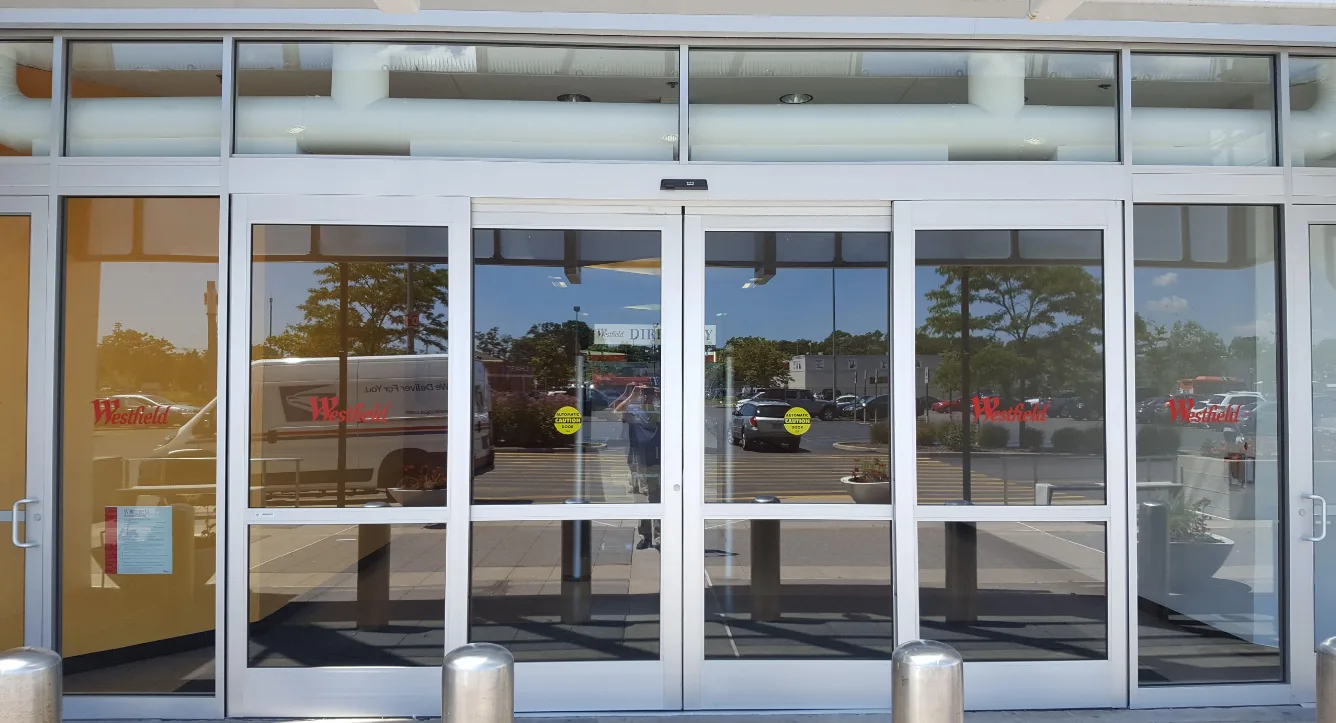
ADA door hardware requirements under the 2010 ADA Standards for Accessible Design (ADA 404): (1) handles must be operable with one hand without tight grasping or twisting - lever handles required, round knobs prohibited on public access doors, (2) interior doors must open with no more than 5 lbf of.
- 20+Years on the Treasure Coast
- 5095-Star Google Reviews
- <30 minTypical Port St. Lucie Response
- $89-150Most Emergency Calls

ADA 404: Door Hardware in the Standards
The 2010 ADA Standards for Accessible Design (specifically Section 404) governs door hardware in places of public accommodation. This applies to every business, medical office, restaurant, retail store, church, and public-facing office on the Treasure Coast.
The requirements are not suggestions or best practices - they're federal law under Title III of the Americans with Disabilities Act. Violations are enforced through private lawsuits (any affected person can sue) and Department of Justice enforcement actions.
The Five Hardware Requirements
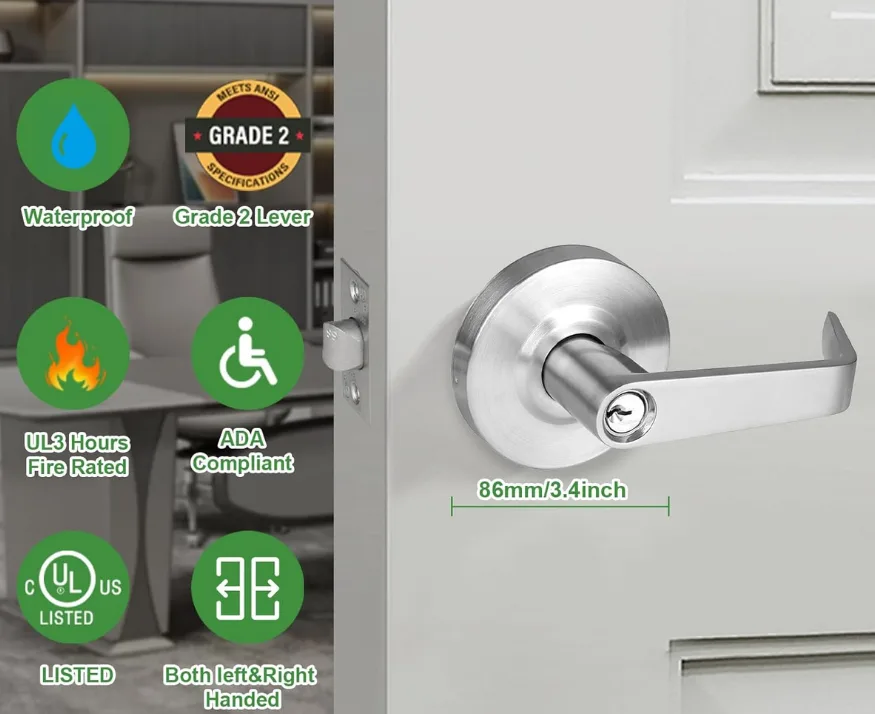
1. Lever Handles Required - Round Knobs Prohibited
ADA 404.2.7: "Handles, pulls, latches, locks, and other operable parts on doors and gates shall comply with 309.4. Operable parts shall be operable with one hand and shall not require tight grasping, pinching, or twisting of the wrist."
In practical terms: lever handles are required. Round knobs are prohibited on doors that the public uses because they require grip-and-twist motion. People with arthritis, limited hand strength, or hand injuries cannot operate round knobs - the twisting motion requires grip strength that many people don't have.
What to replace:
- Round door knobs on any public-access door → lever handles
- Small thumb-turn deadbolts on public-access exit doors → lever-operated or single-motion exit devices
- Round knobs on restroom doors → lever handles with privacy function
What's exempt: Doors that are not in the accessible route (mechanical rooms, storage closets not used by the public) and doors that require a security key for access regardless (restricted-access areas). However, all means of egress must be accessible regardless of normal access restrictions.
2. Maximum 5 lbf Opening Force (Interior Doors)
ADA 404.2.9: Interior doors must open with no more than 5 pounds of force (5 lbf). This is measured at the latch-side edge of the door with a calibrated push-pull force gauge.
What counts: The total force to open the door from the closed position - including overcoming the latch, the door closer, weatherstripping, and any other resistance. Not just the closer force in isolation.
What's exempt:
- Fire doors - required to have closers for fire separation, and the closer force needed for positive latching often exceeds 5 lbf. Fire doors are exempt from the 5 lbf maximum but should be set to the minimum force that ensures positive latching.
- Exterior doors - no ADA force limit. Exterior doors face wind pressure, weather seal compression, and HVAC pressure differentials that make low-force operation impractical.
How to fix a door that exceeds 5 lbf:
- Adjust the door closer - reduce the spring tension (not the speed valves). This is the cheapest fix ($25-$75 for a technician visit).
- Replace the closer with a lower-force model - some closers can't be adjusted low enough. A lower spring-size closer may be needed ($200-$500 installed).
- Install an automatic door operator - the nuclear option. A push-button or sensor-activated operator opens the door mechanically. Eliminates the force issue entirely. Cost: $1,500-$5,000 installed.
3. Maximum 1/2 Inch Threshold
ADA 404.2.5: Thresholds at doorways shall not exceed 1/2 inch in height. Existing/altered buildings: 3/4 inch maximum with beveled edge. Any threshold above these limits creates a trip hazard and a barrier for wheelchair users.
Common violations: Exterior door thresholds that have shifted or been replaced with non-ADA-compliant products. Transition strips between flooring types at doorways. Weather seal thresholds on exterior doors.
Fix: Replace the threshold with an ADA-compliant model ($50-$200 per threshold) or grind/modify the existing threshold. For new installations, specify ADA-compliant thresholds from the outset.
4. Closing Speed: 5 Seconds Minimum
ADA 404.2.8.1: Door closers must allow at least 5 seconds from 90 degrees to 12 degrees before the latch engages. This gives a person using a wheelchair or walker enough time to clear the doorway before the door closes.
Testing: Open the door to 90 degrees, release, and time how long it takes to reach 12 degrees from closed (approximately the point where the latch phase begins). If less than 5 seconds, slow the sweep speed on the closer. See our door closer maintenance guide for adjustment procedures.
5. Hardware Height: 34-48 Inches
ADA 404.2.7: Door hardware must be installed 34-48 inches above the floor. This ensures hardware is reachable from a seated position (wheelchair) and doesn't require excessive reaching or bending. Standard residential installation height (36-40 inches for knobs/levers, 42-44 inches for deadbolts) typically complies.
ADA Lawsuits in Florida: The Real Risk
Florida has one of the highest volumes of ADA Title III lawsuits in the nation. Serial ADA plaintiffs and their attorneys file thousands of cases annually against Florida businesses - restaurants, medical offices, retail stores, professional offices. The business model for serial filers: identify a violation, file suit, and settle for $5,000-$25,000 (less than the cost of litigation for the business).
The legal exposure:
- No caps on attorney's fees: Under ADA, the plaintiff's attorney fees are paid by the losing defendant. Cases that cost $5,000 to settle cost $50,000+ if litigated to judgment because of attorney fee accumulation.
- Injunctive relief: Courts can order the business to remediate ALL violations - not just the one alleged. An ADA inspection prompted by a lawsuit often reveals additional violations that must be fixed.
- Repeat violations: A business that's been sued and settles is not immune to future suits. If the same violation persists (or new ones exist), another plaintiff can file another case.
- State law amplification: Florida's own accessibility statute (F.S. 553.5141) provides additional remedies beyond federal ADA.
The cost calculation is simple: spending $500-$5,000 to comply with ADA door hardware requirements eliminates the risk of $10,000-$75,000+ in legal exposure. Compliance is cheaper than litigation in every scenario.
ADA Compliance Testing: How to Check Your Business
Walk through your business with this checklist:
Entry Doors
- Are all handles levers or push/pull bars (not round knobs)?
- Is hardware installed 34-48 inches above the floor?
- Is the threshold 1/2 inch or less?
- Does the door closer allow 5 seconds from 90 degrees to 12 degrees?
Interior Public-Access Doors
- All handles: levers (not knobs)?
- Opening force: 5 lbf or less? (Use a force gauge - $25-$50 for a spring gauge.)
- Closing speed: 5 seconds from 90 to 12 degrees?
- Hardware height: 34-48 inches?
Restroom Doors
- Lever handles with privacy function (push-button or thumbturn lock - not round knob)?
- Opening force: 5 lbf or less?
- Door width: 32 inches minimum clear opening?
Exit Doors
- Operable from the exit side with one hand, one motion?
- No special knowledge required to exit? (No double-cylinder deadbolts.)
- Panic hardware on assembly occupancy doors (50+ occupants)?
Common ADA Door Hardware Violations on the Treasure Coast
Based on our commercial service across Port St. Lucie, Stuart, Fort Pierce, and Vero Beach, these are the violations we encounter most frequently:
- Round knobs on public restrooms (#1 most common): Older buildings (pre-1992 construction) frequently have round knobs on restroom doors. Fix: replace with lever handles - $75-$200 per lock installed.
- Interior doors exceeding 5 lbf: Door closers adjusted too tight (often intentionally, to keep doors closed for HVAC reasons). Fix: adjust closer - $25-$75 per lock. If adjustment isn't sufficient, replace the closer or install an automatic operator.
- Threshold violations: Especially at exterior-to-interior transitions. Thresholds shift, settle, or were replaced with non-compliant products. Fix: replace threshold - $50-$200 per lock.
- Closing speed too fast: Closers set for speed rather than accessibility. A door that snaps shut in 2 seconds hits wheelchair users. Fix: slow the sweep speed - included in any closer adjustment visit.
- Hardware height violations: Rare on standard doors but common on non-standard installations (custom hardware, retrofit electronic access, secondary locks installed above standard height). Fix: relocate hardware to 34-48 inch range.
Automatic Door Operators: When They're Needed
When a door closer can't be adjusted to meet the 5 lbf force limit (common on heavy fire doors and exterior doors), an automatic operator is the compliance solution. The operator opens the door mechanically when activated by:
- Push button: Mounted on the wall beside the door, at wheelchair-accessible height. Push the button, the door opens automatically and holds for a set duration.
- Motion sensor: The door opens when someone approaches. Common on high-traffic entries where a push button creates a bottleneck.
- Wave sensor: Hold your hand near the sensor panel and the door opens. More intentional than a motion sensor (doesn't activate for passing foot traffic).
Cost: $1,500-$3,000 for a standard push-button operator installed. $2,500-$5,000 for sensor-activated operators with more sophisticated controls. For high-traffic commercial entries, the operator also reduces HVAC loss by controlling opening duration.
On the Treasure Coast, we install automatic operators from Norton, LCN, and ASSA ABLOY on commercial entries, medical offices, and any business where the 5 lbf requirement can't be met through closer adjustment alone. Call (772) 758-1322 for ADA door hardware compliance assessment.
Related Services