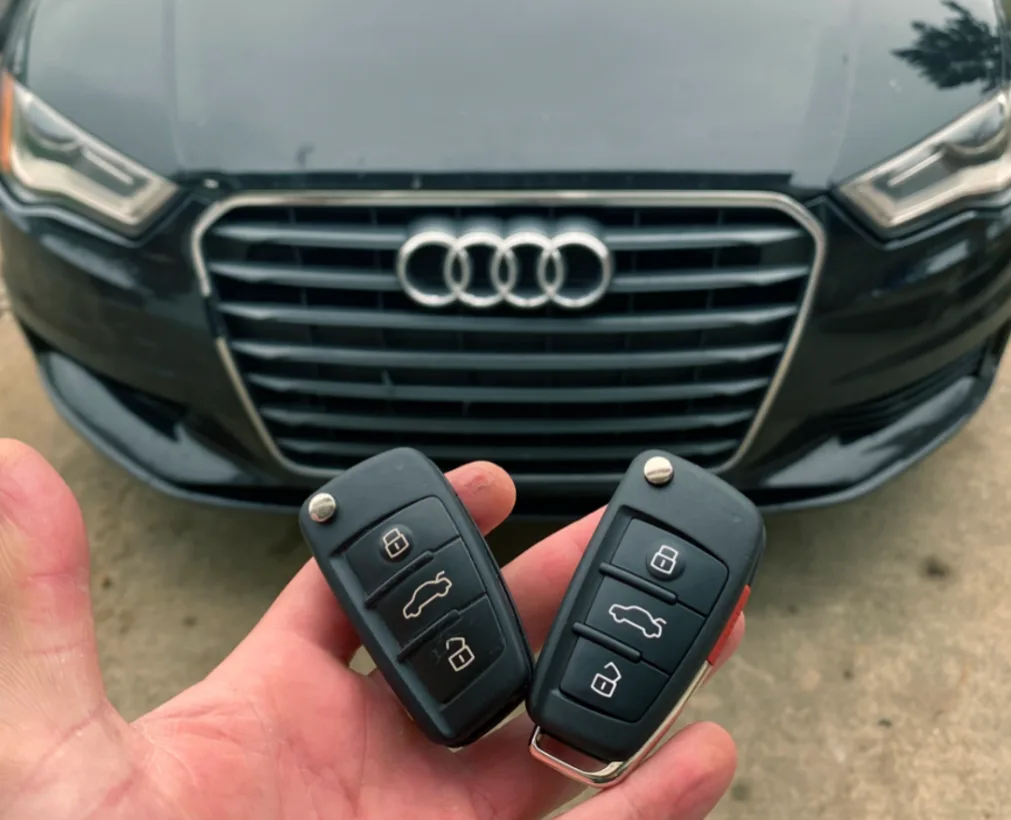
A transponder key contains a tiny electronic chip that communicates with your vehicle's immobilizer system using radio signals. When you insert the key, the immobilizer antenna reads the chip's unique code. If the code matches, the engine starts.
- 20+Years on the Treasure Coast
- 5095-Star Google Reviews
- <30 minTypical Port St. Lucie Response
- $89-150Most Emergency Calls

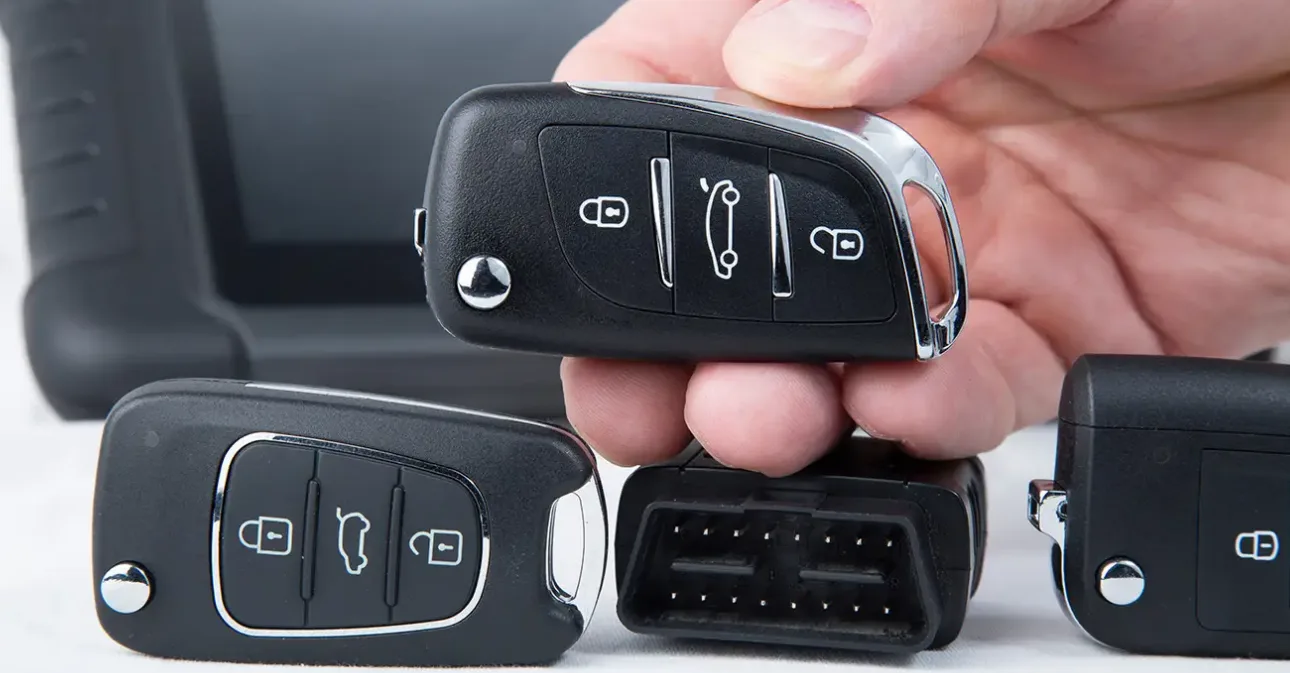
How Transponder Keys Work
The word "transponder" combines "transmitter" and "responder." The chip inside your key both transmits and responds to signals from your vehicle's immobilizer system. Here's the sequence that happens every time you start your car:
- Insert key. You put the key in the ignition (or for proximity keys, bring the fob near the vehicle).
- Antenna activates. An antenna ring around the ignition cylinder sends a low-power radio signal that energizes the transponder chip in the key. The chip has no battery - it's powered by the antenna's electromagnetic field.
- Chip responds. The energized chip transmits its unique encrypted code back to the antenna.
- Computer verifies. The vehicle's Engine Control Module (ECM) or Body Control Module (BCM) receives the code and compares it against stored authorized codes.
- Match = start. If the code matches, the immobilizer allows the engine to start normally.
- No match = disabled. If the code doesn't match (wrong key, cloned key, no chip), the immobilizer disables the fuel injection and/or ignition system. The engine cranks but won't start.
This entire sequence takes milliseconds. You never notice it happening - the car just starts (or doesn't).
Why This Technology Exists
Before transponder immobilizers, car theft was disturbingly easy. A screwdriver in the ignition, a hot-wired ignition switch, or a shaved key could start most cars in under 60 seconds. Car theft rates in the 1990s were astronomical compared to today.
The introduction of transponder immobilizers in the mid-to-late 1990s changed everything. According to the Insurance Information Institute, vehicle theft rates dropped dramatically after transponder systems became widespread. The immobilizer made "casual" car theft - screwdriver-and-go - essentially impossible on equipped vehicles.
Today, virtually every vehicle manufactured since 1998 has some form of transponder immobilizer. European manufacturers started earlier (mid-1990s); American and Asian manufacturers followed by 1998-2002. If your car was built this century, it almost certainly has a transponder key.
Types of Transponder Systems
Different manufacturers use different transponder technologies. Understanding which system your vehicle uses helps explain programming requirements and costs.
Fixed Code Transponders (Early Generation)
The chip transmits the same code every time. Simpler technology from the late 1990s. Potentially vulnerable to code capture (recording the signal) but still effective against physical hot-wiring.
Found in older Ford, Toyota, and GM vehicles.
Rolling Code / Encrypted Transponders (Current Standard)
The chip and vehicle computer use an encrypted challenge-response protocol. The code changes with every use, making signal capture useless. Modern Toyota, Honda, Ford, GM, and most current vehicles use this technology.
Significantly harder to defeat than fixed-code systems.
Major Manufacturer Systems
- Ford PATS (Passive Anti-Theft System): Ford's transponder system since 1996. Uses encrypted communication between key chip and PCM. Different PATS generations require different programming approaches.
- Toyota G-Chip / H-Chip: Toyota's transponder designations. G-chip is an older standard; H-chip is newer with stronger encryption. The chip type determines programming equipment requirements.
- Honda HISS (Honda Immobilizer Soldering System): Honda and Acura's immobilizer system. Each key is registered to the ECU individually.
- GM PassKey / PassLock / PK3+: General Motors has used several immobilizer generations. Older PassLock used a resistor chip; newer PK3+ uses encrypted transponder.
- Chrysler/Dodge Sentry Key: FCA's transponder system using specific chip types for different model years.
- BMW CAS/FEM/BDC: BMW's advanced immobilizer systems that require specialized programming equipment.
- Mercedes EIS/FBS: Mercedes-Benz uses some of the most complex immobilizer systems in the automotive world.
Why Transponder Keys Cost $150-$350
Parents who remember $5 brass car keys understandably react with shock to $150-$350 transponder key pricing. Here's what you're paying for:
The chip itself ($20-$80). The transponder chip is an electronic component - tiny but manufactured to automotive specifications. Different vehicles require different chip types (Texas Instruments, Philips/NXP, Megamos). The blank key with embedded chip costs $20-$80 wholesale depending on vehicle.
Cutting ($10-$30). Modern keys use laser-cut or sidewinder patterns (not the traditional edge-cut of old brass keys). These require precision cutting machines. The physical cut allows the key to turn in the ignition; the chip allows the engine to start.
Programming equipment ($3,000-$15,000). The tools needed to program transponder chips - Autel IM608 Pro II ($5,000+), Xhorse VVDI Key Tool Plus ($3,000+), Smart Pro ($4,000+) - are serious professional investments. These tools communicate with your vehicle's immobilizer computer to register new key chips. The equipment cost is amortized across every key service.
Technical expertise. Each vehicle brand, model, and year has specific programming procedures. Locksmith training, manufacturer documentation, and experience with thousands of different vehicles all factor into the skill required. This isn't $12/hour hardware store work - it's skilled automotive electronics.
Mobile service. The locksmith drives to your location with $10,000-$20,000 of equipment on a service truck. No appointment scheduling at a dealer, no towing, no rental car. Convenience has value.
| Service | Flat-Rate Cost | After-Hours Add | Notes |
|---|---|---|---|
| Residential lockout | $89 - $150 | +$20 - $40 | Most common emergency call; under 30 min response in Port St. Lucie |
| Automotive lockout | $89 - $150 | +$20 - $40 | Tools + common key blanks on-truck |
| Commercial lockout | $125+ | +$30 - $50 | Storefront, panic-bar, mortise hardware |
| Car key replacement | $150+ | +$30 - $50 | Cutting + transponder programming on-site |
| Rekey (per cylinder) | $20 - $40 | n/a | Often added to a lockout call same trip |
| Broken key extraction | $75 - $125 | +$20 - $40 | Frequently paired with a rekey |
All pricing quoted flat-rate before work begins. Florida-licensed, fully insured, written receipt provided.
Why Hardware Store Copies Don't Work
This is the #1 customer confusion about modern car keys. You take your car key to Home Depot or Lowe's, the kiosk cuts a perfect physical copy for $3, and... it doesn't start your car. You can unlock the doors manually, but the engine won't fire.
The reason: the hardware store copy has no transponder chip. It's a perfect physical match (the grooves and cuts are identical) but it contains no electronics. When you insert the chipless copy, the immobilizer antenna reads... nothing.
No signal means no match. No match means no start.
A hardware store copy is useful for exactly one thing: manually unlocking the door if you're locked out. It won't start the engine. For a working key, you need a transponder blank ($20-$80) programmed by professional equipment ($3,000-$15,000) operated by a trained locksmith or dealer.
Treasure Coast Transponder Key Service
On the Treasure Coast - Port St. Lucie, Stuart, Vero Beach, Fort Pierce, Jensen Beach, Palm City, Sebastian, and surrounding cities - Treasure Coast Locksmith programs transponder keys for virtually every vehicle on the road. Mobile service brings the programming equipment to your location.
Most common Treasure Coast transponder key requests: Ford F-150 (PATS system, very common work truck), Toyota Camry and RAV4 (G/H chip), Honda CR-V and Civic (HISS), Chevy Silverado (PK3+), Hyundai Tucson and Kia Sportage (immobilizer). Luxury vehicles (BMW, Mercedes, Lexus, Audi) also handled with specialized equipment.
Response time: 30-60 minutes to most Treasure Coast locations. Programming time: 30-90 minutes depending on vehicle and key type. Cost: $145-$595 depending on vehicle and whether you have an existing working key.
Related Services
- Transponder Key Service
- Car Key Replacement
- Car Key Programming
- Key Fob Replacement
- Smart Key Push-to-Start
- Automotive Locksmith