Treasure Coast Locksmith provides home safe installation services in Port St. Lucie, Stuart, Fort Pierce, Vero Beach, Jensen Beach, and across the Treasure Coast. Call (772) 758-1322 for mobile service. Home safe installation includes delivery, placement, anchoring to concrete slab or framing, combination setup, and operation training. Treasure Coast Locksmith installs Sentry, Honeywell, AMSEC, Liberty, and Barska home safes across every Treasure Coast city. $175-$485 depending on safe size and anchoring difficulty.
A home safe without proper installation is a decorative box. Unanchored safes under 1,000 lbs can be carried out during a burglary - and burglars know it. The entire point of a safe is that it stays put even under duress, which requires proper anchoring to the structure.
Treasure Coast Locksmith installs home safes with concrete-slab anchoring (standard for ground-floor installations) or framing anchoring (for second-floor and upper installs). We install every major residential brand including Sentry, Honeywell, AMSEC, Liberty, Winchester, Cannon, and Barska.
Typical installation is 45-90 minutes including delivery, placement, anchoring, and combination setup. For larger gun safes (500+ lbs) we bring additional crew and equipment for proper handling.

What home safe installation includes
- Delivery and placement - we bring the safe to your room of choice.
- Concrete slab anchoring - 1/2 inch expansion bolts through factory holes.
- Upper floor anchoring - into framing when slab is not accessible.
- Combination setup - set or change the factory combination.
- Leveling and adjustment - ensures smooth bolt-work operation.
- Operation training - 5-10 minute walk-through for the owner.
- Insurance documentation - written invoice for coverage records.
- Marine-grade fasteners - for coastal moisture resistance.
Why anchoring matters more than safe brand
The installation matters as much as the safe itself. Here's why.
Common home safe situations
- Homeowner bought a 250 lb Sentry fireproof safe and placed it in the closet unanchored. Burglary took the whole safe.
- Liberty gun safe installed on a second floor without framing anchoring - safe shifted and blocked bedroom door.
- AMSEC BF home safe installed by previous owner on carpet padding; the padding compressed and leveled shifted over time.
- Honeywell fire safe needed to be moved from closet to office during a renovation. We handled the move and re-anchoring.
- Coastal Hutchinson Island home with a Sentry safe where the anchor bolts corroded over 5 years. Replaced with marine-grade.
- Retired owner wanted a safe installed in a specific room but the floor was suspended wood; we added a steel plate for anchoring.
- Palm City homeowner needed a gun safe installed but had only a garage with concrete floor - perfect for anchoring.
- Vero Beach homeowner had a safe delivered but assembly required professional moving equipment because of the 650 lb weight.
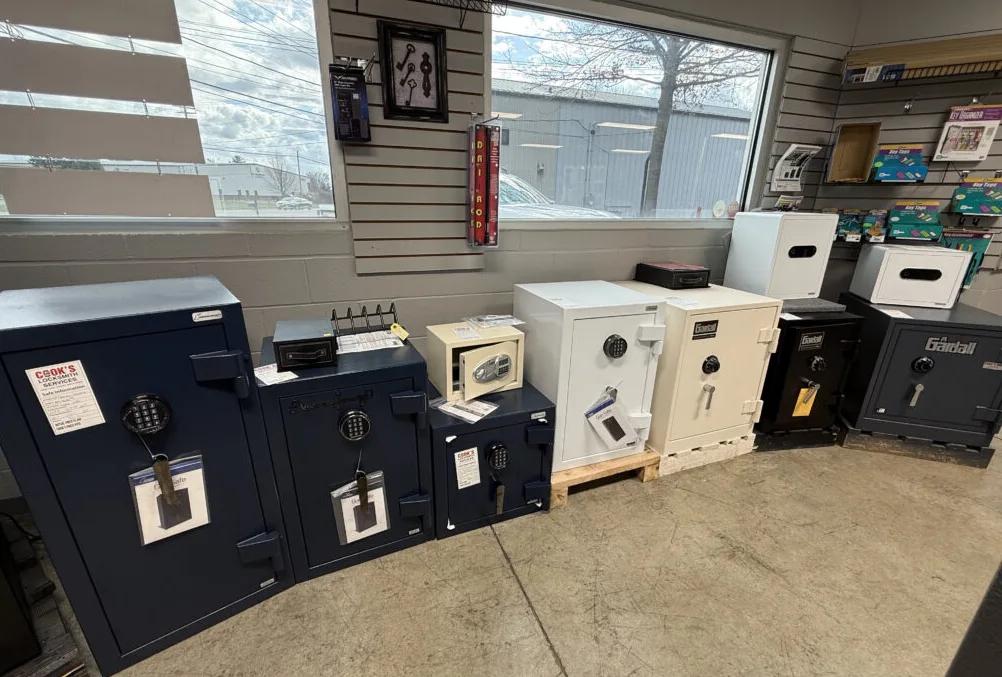
Home safe types and installation considerations
Three categories of home safes cover most residential needs. Fireproof safes (Sentry, Honeywell, First Alert) protect documents and valuables from fire damage. They are typically lighter (50-200 lbs) and can be anchored with standard concrete expansion bolts.
Gun safes (Liberty, Cannon, Browning, Winchester) are heavier (300-900+ lbs) and often come with larger factory anchoring holes for 5/8 inch bolts. High-security safes (AMSEC BF, Mesa, Amsec TL-15) combine fire protection with theft protection and have the most robust anchoring requirements.
Proper anchoring requires matching the anchor type to the floor. Concrete slab floors are ideal - 1/2 inch (or 5/8 inch for larger safes) Hilti or Red Head expansion bolts provide 1,500-3,000 lbs of pull-out strength per bolt. Most home safes have 4 anchor holes, giving 6,000-12,000 lbs of total holding force.
Second-floor wood-framed floors require different treatment. Anchor bolts into framing joists (not just subfloor plywood) provide adequate holding force for most residential safes. We verify framing location with a stud finder and sometimes drill diagonally to catch a joist.
For very heavy gun safes (500+ lbs) we sometimes install a steel plate under the safe to distribute load and provide better anchoring surface.
How a home safe installation works
Assessment call
Call (772) 758-1322 with the safe brand, model, and approximate weight.
Delivery and placement
We bring the safe to the install location, usually with an appliance dolly.
Anchoring
Drill through factory anchor holes into concrete or framing. Install expansion bolts.
Combination setup and training
Set or reset the combination, teach operation, verify bolt work operation.
Home safe ownership tips
- Always anchor a safe, even small ones. Unanchored safes walk out during burglaries.
- Place home safes against interior walls, not exterior. Exterior walls are thinner and easier to breach around the safe.
- Store the combination separately from the safe - with a trusted person or in a bank deposit box.
- Replace the electronic lock battery annually even if the lock says the level is fine.
- Keep documents inside a waterproof container inside the safe. Fire ratings don't cover water damage from firefighting.
- For gun safes, add a dehumidifier (Eva-Dry or Golden Rod) to prevent rust on contents. Essential on the coast.
Related services
Other Treasure Coast Locksmith services in this cluster.
Home safe installation FAQs
Common questions from Treasure Coast homeowners about safe installation.
How much does home safe installation cost?
Standard fireproof safe installation (50-200 lb) runs $175 to $285 including anchoring. Larger safes (200-500 lb) run $225 to $385. Gun safes (500+ lb) run $325 to $585 because of additional moving equipment.
Price includes delivery from your location, placement, anchoring, combination setup, and training.
Do you deliver the safe, or do I need to?
We can deliver from a local retailer or from your location if you already have the safe. We can also pick up from certain Treasure Coast safe retailers and deliver direct to your home. Delivery and installation are quoted together for simpler billing.
How long does safe installation take?
Small fireproof safes: 30-45 minutes including anchoring and training. Medium safes (200-500 lb): 45-75 minutes. Large gun safes: 60-120 minutes depending on floor type and anchoring complexity.
Most jobs finish in a single morning or afternoon visit.
Can you install a safe on the second floor?
Yes. Second-floor installations require anchoring into framing joists rather than concrete slab. We locate joists with a stud finder and drill through factory anchor holes into the joist wood.
For very heavy safes (500+ lbs) we sometimes add a steel plate to distribute load.
Will anchoring damage my floor?
Minimally. Anchor bolts create 4 small holes (1/2 or 5/8 inch diameter) through whatever flooring covers the concrete or wood. For tile or wood floors we drill through carefully to minimize chipping.
The holes are only visible if the safe is later removed.
Can you anchor a safe to a wood floor without a concrete slab below?
Yes, for safes up to about 600 lbs. We anchor through factory holes into framing joists using lag bolts. For larger safes we recommend relocating to a ground-floor slab if possible, because the holding strength of joist anchoring is limited.
What safe brands do you install?
Sentry, Honeywell, First Alert, AMSEC, Liberty, Cannon, Browning, Winchester, Barska, Stack-On, Fort Knox, Rhino Metals, and Tracker Safe. For uncommon brands we install as long as the safe has factory anchor holes and matches standard residential weight ranges.
Do you set the combination during installation?
Yes. We set the combination to whatever code you prefer. For mechanical dial safes, this requires opening the cover of the combination lock and resetting the wheels.
For electronic safes, this is a keypad procedure. Either way, it's included in the installation at no extra charge.
Can you move a safe I already own?
Yes. Safe moving is a common service. Small safes (under 300 lbs) are straightforward dolly jobs.
Larger safes require appliance dollies and stair climbers. Gun safes (500+ lbs) need a crew. We quote based on weight, destination, and stair count.
What about safes for oceanfront homes?
For oceanfront homes we recommend marine-grade stainless anchor bolts instead of standard zinc. Humidity and salt air corrode standard anchor hardware within a few years. We also recommend adding a dehumidifier inside the safe to protect contents from moisture damage.
Do I need a special permit to install a home safe?
No. Home safe installation is not a permitted building activity. You can install any size safe in your home without permit approval from the city or county.
HOAs sometimes have noise restrictions for drilling during installation hours, but permits are not required.
Can you install a wall safe that's hidden behind a picture?
Yes. Wall safes install between wall studs and can be concealed behind a picture, mirror, or decorative cover. We cut the wall opening, install the safe flush with the wall, and finish the surrounding drywall.
Wall safe installations typically take 90-180 minutes including drywall finishing.