Commercial door closers (LCN, Norton, Sargent, Yale) last 15-20 years with basic annual maintenance - and fail in 3-5 years without it. Annual maintenance takes 30 minutes per door and costs $25-$75 per closer for professional service. Emergency replacement of a failed closer costs $400-$1,200 (parts + labor + downtime).
- 20+Years on the Treasure Coast
- 5095-Star Google Reviews
- <30 minTypical Port St. Lucie Response
- $89-150Most Emergency Calls
What a Door Closer Actually Does
A commercial door closer is a hydraulic device that controls the closing speed and force of a door. Inside the metal body: a spring, a piston, and hydraulic fluid (oil). When you push the door open, the spring compresses and the piston pushes oil through calibrated channels.
When you release the door, the spring drives the piston back, and the oil flowing through those channels controls how fast the door closes.
It's a simple mechanical device - which is why it's so reliable when maintained and so predictable when it fails. The failure mode is always the same: oil leaks out, hydraulic control is lost, the door slams or won't close, and the closer needs replacement.
The Three Closing Phases
Every commercial door closer controls three distinct phases of the closing cycle. Understanding these phases is essential for proper adjustment:
Phase 1: Sweep (Main Closing)
From fully open to about 15 degrees from closed. This is the main closing arc. The sweep speed valve controls how fast the door moves through this range.
Too fast: the door swings aggressively and could strike someone. Too slow: the door stays open too long, letting conditioned air escape and compromising fire separation.
Proper sweep: the door should close from full open to near-closed in 5-8 seconds. This is fast enough for energy efficiency and fire safety, slow enough that someone walking behind you has time to catch the door.
Phase 2: Latch (Final Snap)
The last 15 degrees of closing. The latch speed valve controls this phase independently. The door needs enough final velocity to engage the latch bolt into the strike plate - but not so much that it slams.
Wind pressure, HVAC pressure differentials, and weatherstripping resistance all fight the latch phase.
If your door closes smoothly but doesn't quite latch (the bolt doesn't catch), the latch speed needs to increase. If the door slams shut in the last inch, the latch speed needs to decrease.
Phase 3: Backcheck
Not a closing phase - backcheck resists the door being thrown open too far. When someone pushes a door aggressively (wind gust, someone in a hurry, wheelchair user with momentum), backcheck provides hydraulic resistance after about 70 degrees of opening. This prevents the door from slamming into the wall, damaging the wall stop, or straining the closer's arm.
Backcheck should be firm enough to prevent wall damage but not so stiff that it makes the door hard to open. Test by pushing the door open quickly - you should feel increasing resistance past the halfway point.
The Annual Maintenance Checklist
1. Visual Inspection (2 Minutes)
- Oil on the closer body, arm, or bracket: Any visible oil means internal seals are leaking. This is the #1 failure indicator. A closer with visible oil has months to a couple of years of remaining life - start budgeting for replacement.
- Mounting screws: Check all screws on the closer body and the arm bracket. Loose screws cause the closer to shift under load, accelerating wear and misalignment. Tighten any loose screws.
- Arm condition: Look for bent or cracked arm segments. A bent arm means the door has been forced or propped open against the closer's resistance. The arm should be straight and move smoothly through its full range.
- Closer body position: The closer should be mounted flat against the frame or door header - not angled, shifted, or pulling away from the mounting surface.
2. Speed Adjustment (5-10 Minutes)
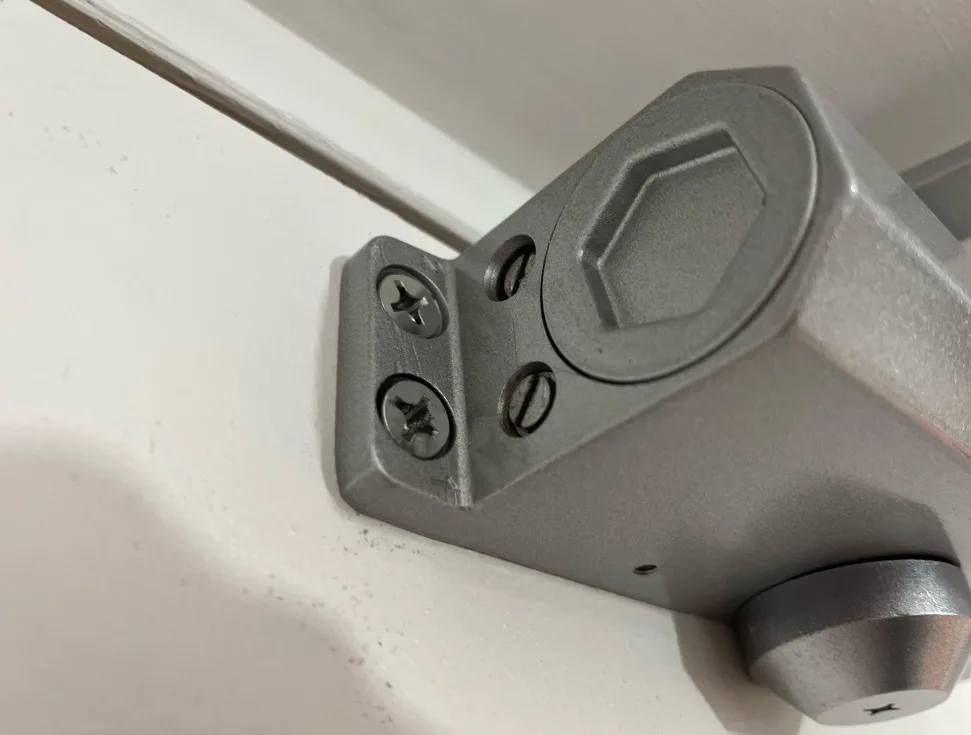
Adjustment valves are typically on the end or side of the closer body - small slotted screws accessible with a flathead screwdriver. Each valve is labeled (or identified in the manufacturer's documentation):
- Sweep valve: Turn clockwise to slow down, counterclockwise to speed up. Adjust in 1/4-turn increments and test.
- Latch valve: Same adjustment direction. Set independently from sweep - the door needs more velocity in the last 15 degrees than in the main arc.
- Backcheck valve: Adjust to control opening resistance. Rarely needs changing once set correctly.
Critical rule: Never turn an adjustment valve more than 2 full turns from the factory position. Over-adjusting can blow out the valve seal, causing catastrophic oil loss. If adjustment within the normal range doesn't achieve the desired speed, the closer has an internal problem - not an adjustment problem.
3. ADA Force Testing (5 Minutes)
The Americans with Disabilities Act (ADA) requires interior doors in public buildings to open with no more than 5 pounds of force (5 lbf). Fire doors are exempt from the 5 lbf limit but must still be adjustable.
Testing requires a push-pull force gauge ($25-$50 for a basic spring gauge). Place the gauge on the door at the latch-side edge (where a person pushes), measure the force required to open the door from the closed position. If it exceeds 5 lbf on an interior door, adjust the closer's spring tension (not the speed valves - the spring tension adjustment is separate and usually located under a cover plate on the closer body).
ADA compliance is not optional. Violations expose the business to lawsuits under Title III, and the U.S. Department of Justice enforces penalties.
Annual force testing with documentation is your liability protection.
4. Lubrication (3 Minutes)
Apply a light machine oil or silicone spray to:
- Arm pivot points (where the arm segments connect to each other and to the closer/bracket)
- Slide track channel (if it's a slide-track closer rather than a regular arm)
- Spring tube connections (if accessible)
Do NOT oil the adjustment valves, the closer body seals, or the mounting screws. Over-lubrication attracts dust and debris that accelerates wear. A light application at pivot points is sufficient.
5. Function Test (3 Minutes)
After all adjustments:
- Open the door fully and release. It should close smoothly, accelerate slightly at the latch phase, and latch positively.
- Open the door quickly to test backcheck - firm resistance past 70 degrees, not a hard stop.
- Open and close the door 5 times rapidly - the speed should be consistent each cycle. Inconsistent closing speed indicates internal valve problems.
- Hold the door at 90 degrees for 10 seconds, then release - it should close at the same speed as a quick release. Delayed closing after holding indicates a worn piston seal.
Major Door Closer Brands and Their Quirks
LCN (Allegion)
The LCN 4040XP is arguably the most common commercial door closer in America. Extremely durable, well-documented, and with widely available parts. LCN closers use a cast-iron body that resists damage and provides excellent thermal stability.
Adjustment valves are clearly marked and respond predictably. The 4040XP series has a track record of 20+ year lifespans with annual maintenance.
Norton (ASSA ABLOY)
Norton closers are common in institutional settings (schools, hospitals, government buildings). The 7500 series is their workhorse. Norton closers tend to have slightly stiffer spring options out of the box - useful for exterior doors with wind load but requiring more careful ADA adjustment for interior applications.
Sargent (ASSA ABLOY)
The Sargent 281 series appears in mid-range commercial applications. Reliable but with a smaller parts distribution network than LCN. If your building has Sargent closers and needs replacement, consider whether to stay with Sargent (consistent appearance) or switch to LCN (wider parts availability for future maintenance).
Yale (ASSA ABLOY)
Yale commercial closers (2700 series) are lighter-duty than LCN but adequate for standard interior commercial doors. Commonly found in office buildings and light commercial spaces on the Treasure Coast.
When to Repair vs Replace
Repair (Adjust, Lubricate, Tighten)
- Door closing speed has changed but the closer has no oil leak - adjustment only.
- Door doesn't latch - usually a latch speed adjustment or strike plate alignment issue.
- Arm is loose - tighten or replace the arm (arms are replaceable separately from the closer body).
- Mounting screws are stripped - install longer screws or heli-coil inserts in the frame.
Replace (New Closer Required)
- Oil leak from closer body: Internal seals are failing. Once oil starts leaking, it's a countdown to hydraulic failure. Replacement is the only fix - closers are not rebuildable in the field.
- Adjustment has no effect: You turn the sweep valve and nothing changes. Internal valve channels are clogged, worn, or the oil level is too low for hydraulic control. Replace.
- Closer body is cracked or damaged: Physical damage to the cast housing. Uncommon but happens with impact (furniture movers, door abuse). Replace immediately - a cracked housing will fail under load.
- Closer is more than 20 years old with any problem: At 20+ years, repair costs approach replacement costs and the remaining lifespan is limited regardless. Replace proactively.
Cost Comparison: Maintenance vs Emergency
| Scenario | Cost |
|---|---|
| Annual maintenance (adjust, lubricate, test) per closer | $25-$75 |
| 15 years of annual maintenance (total) | $375-$1,125 |
| Emergency closer replacement (failed closer, same-day) | $400-$1,200 |
| Emergency replacement with fire door compliance issues | $800-$2,000+ |
| ADA violation fine (per occurrence, per lock) | $75,000+ |
Annual maintenance for a single closer costs less than 10% of emergency replacement. Over the 15-20 year lifespan of a maintained closer, you spend $375-$1,125 total on maintenance instead of $400-$1,200 on a single emergency replacement - and the maintained closer lasts the full 15-20 years instead of failing at 5-7.
| Service | Flat-Rate Cost | After-Hours Add | Notes |
|---|---|---|---|
| Residential lockout | $89 - $150 | +$20 - $40 | Most common emergency call; under 30 min response in Port St. Lucie |
| Automotive lockout | $89 - $150 | +$20 - $40 | Tools + common key blanks on-truck |
| Commercial lockout | $125+ | +$30 - $50 | Storefront, panic-bar, mortise hardware |
| Car key replacement | $150+ | +$30 - $50 | Cutting + transponder programming on-site |
| Rekey (per cylinder) | $20 - $40 | n/a | Often added to a lockout call same trip |
| Broken key extraction | $75 - $125 | +$20 - $40 | Frequently paired with a rekey |
All pricing quoted flat-rate before work begins. Florida-licensed, fully insured, written receipt provided.
Property Manager Annual Schedule
For Treasure Coast commercial properties and HOA common areas, we recommend this annual schedule:
- January: Schedule annual door closer inspection for all building closers. One visit covers all doors - volume pricing applies.
- During visit: Each closer: visual inspection, speed adjustment, ADA force test (with documented readings), lubrication, hardware check. 15-30 minutes per door.
- Report: Written report per door: current condition, adjustments made, ADA readings, any closers flagged for replacement within the next 12 months.
- Budget: The report identifies closers nearing end-of-life so you can budget scheduled replacement instead of emergency replacement.
This proactive approach eliminates emergency failures, maintains ADA compliance documentation, and extends closer lifespan to maximum. Call (772) 758-1322 to schedule annual door closer maintenance for your Treasure Coast commercial property.
Related Services