Treasure Coast Locksmith provides panic hardware retrofit services in Port St. Lucie, Stuart, Fort Pierce, Vero Beach, Jensen Beach, and across the Treasure Coast. Call (772) 758-1322 for mobile service. Panic hardware retrofit upgrades non-compliant commercial doors to NFPA 101 code requirements. Assembly occupancy spaces (50+ occupants) require panic hardware on exit doors. Retrofit includes exit device installation, strike and frame modifications, door preparation, and compliance documentation.
Treasure Coast Locksmith retrofits existing commercial buildings for code compliance across the tri-county.

Many older commercial buildings were built or occupied before current NFPA 101 requirements. When use changes (occupancy increases, new tenant with assembly use, fire marshal inspection flags deficiencies), panic hardware retrofit becomes necessary. Retrofit converts existing commercial doors to exit devices without replacing the entire door.
NFPA 101 Life Safety Code requires panic hardware on exit doors in assembly occupancy spaces with 50+ occupants. Common triggers for retrofit: restaurant expansions, church additions, retail conversions to dining, community center upgrades, and fire marshal citations during inspection.
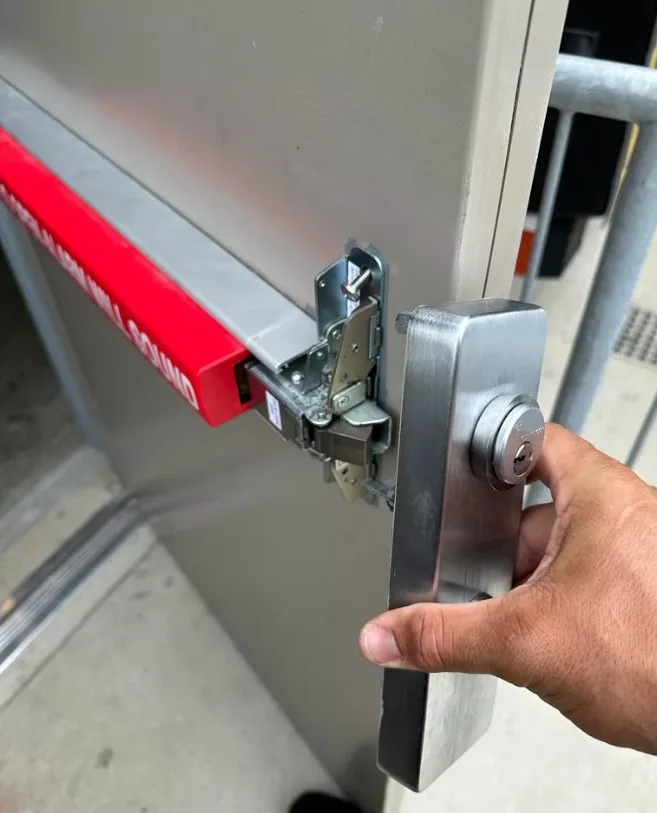
Treasure Coast Locksmith retrofits existing commercial doors with Von Duprin, Sargent, Corbin Russwin, and Yale exit devices. Full service includes door preparation, hardware installation, strike modifications, and compliance documentation suitable for fire marshal review.
Retrofit specialty
- NFPA 101 compliance - assembly occupancy code.
- Von Duprin retrofit - 98/99 series standard.
- Sargent, Corbin options - alternative brands.
- Door modification - prep for exit device.
- Strike installation - rim strikes and mortise.
- Dummy trim option - exterior handles.
- Compliance documentation - fire marshal ready.
- Minimal downtime - fast retrofit service.
Common retrofit scenarios
Real panic retrofit situations.
Typical calls
- Port St. Lucie restaurant expansion requiring panic hardware on new exit doors.
- Stuart church with fire marshal citation for non-compliant sanctuary exits.
- Vero Beach community center with panic hardware upgrade.
- Fort Pierce banquet hall with assembly occupancy retrofit.
- Jensen Beach retail store conversion with assembly use upgrade.
- Tradition office building with conference room assembly compliance.
- Palm City fitness center with exit device installation.
- Treasure Coast school auditorium with panic hardware retrofit.
Assembly occupancy requirements and retrofit process
Panic hardware retrofit involves code analysis, hardware selection, door modification, and installation. Understanding the process helps businesses plan for compliance work.
When Panic Hardware is Required: NFPA 101 assembly occupancy classification applies to spaces with 50+ occupants used for religious, educational, recreational, social, or similar gathering purposes. Common examples: restaurants (dining area), churches, auditoriums, gyms, theaters, banquet halls, community centers, and retail stores converted to assembly use. Assembly spaces need panic hardware on exit doors to allow single-motion egress under panic conditions.
Occupancy Calculation: Building code uses occupant load factors to determine maximum occupancy. Restaurant dining: 15 sq ft per person. Assembly standing: 5 sq ft per person.
Office: 100 sq ft per person. Calculate floor area divided by load factor to determine occupancy. Over 50 typically triggers panic hardware requirement.
Exit Requirements: Assembly spaces with 50-500 occupants require 2 exits minimum. Exits must be remote from each other (at least 1/3 of maximum diagonal dimension apart). Exit doors must have panic hardware and open in the direction of egress travel for 50+ occupancy spaces.
Existing Door Evaluation: Retrofit begins with evaluating existing doors for suitability. Solid-core wood or hollow metal doors in good condition can usually accept retrofit hardware. Hollow-core wood doors may need replacement.
Aluminum storefront doors can accept specific exit devices (Von Duprin 33A/35A). Damaged doors may need repair before retrofit.
Door Modification: Exit devices typically require modifying the existing door. Modification includes:
• Holes drilled for device mounting bolts
• Slot cut for latch mechanism
• Sometimes mortises for CVR (concealed vertical rod) systems
• Strike plate preparation on the jamb
Exit Device Selection: Choose based on door type and application:
• Rim exit devices (Von Duprin 99) - mounted on surface of door, strike on jamb. Most common retrofit.
• Surface Vertical Rod (SVR) - Rods run vertically to top and bottom latches. Used for pair doors or specific configurations.
• Concealed Vertical Rod (CVR) - Rods concealed inside door.
More complex installation but cleaner appearance.
• Narrow Stile (Von Duprin 33A/35A) - Designed for aluminum storefront doors.
• Mortise Exit Device - Integrated with mortise lockset function. Highest security.
Strike Installation: Rim devices use strikes mounted on the jamb. Strike must be secure with appropriate screws. For retrofits, sometimes requires frame reinforcement to provide solid mounting.
SVR and CVR devices have top and bottom strikes.
Dummy Trim: Exit devices provide egress from inside. For entry from outside, dummy trim (pull handle with lock cylinder) provides keyed access. Sometimes thumb-piece trim allows key-free entry during business hours.
Fire-Rated Doors: Exit devices on fire-rated doors must be UL-listed for fire application. Von Duprin 98/99 and other major brands have fire-rated models. Non-rated devices invalidate fire rating.
Documentation: Compliance documentation for fire marshal review includes hardware specification, UL listing for fire-rated applications, installation record, and verification of single-motion egress operation. Standard practice for all retrofit installations.
Panic hardware retrofit process
Code assessment
Call (772) 758-1322. Determine if panic hardware is required for the space.
Door evaluation
Inspect existing doors for retrofit suitability.
Hardware selection
Choose appropriate exit device brand and configuration.
Retrofit installation
Modify door, install device and strike, verify operation.
Panic retrofit tips
- Verify occupancy calculation before assuming retrofit is needed.
- Choose UL-listed devices for fire-rated door applications.
- Plan for dummy trim if exterior entry is needed.
- Document retrofit work for fire marshal review.
- Test single-motion egress after installation.
- Train staff on exit device operation.
Related services
Other Treasure Coast Locksmith services in this cluster.
Panic hardware retrofit FAQs
Common questions from Treasure Coast businesses facing code compliance.
How much does panic retrofit cost?
Single-door retrofit with Von Duprin 99 rim device: $1,195-$1,995. Pair-door retrofit with SVR: $2,495-$3,995. Aluminum storefront retrofit (33A): $1,495-$2,495.
Fire-rated door retrofit: 15-20% premium. Free quote with site visit.
Do I need panic hardware?
Depends on occupancy classification. Assembly occupancy with 50+ occupants requires panic hardware on exit doors. Calculate occupancy using code load factors for your use.
Fire marshal can advise on specific requirements. Free consultation.
What triggers the requirement?
Occupancy 50+ persons in assembly use, use conversions (retail to restaurant, office to community space), expansions, and fire marshal citations during inspection. Sometimes insurance requirements before policy issuance. Specific to each building.
Can any door be retrofitted?
Most solid-core wood and hollow metal doors can be retrofitted. Hollow-core wood doors may need replacement - they can't support exit device mounting. Aluminum storefronts use specific narrow-stile devices.
Evaluation during site visit.
Do you handle fire-rated doors?
Yes. UL-listed exit devices for fire-rated door retrofit. Must use correct rated device to preserve fire rating.
Von Duprin 98/99, Sargent 80 series, and other major brands have fire-rated options. Documentation provided for compliance.
Can I keep the existing lockset?
Sometimes yes, sometimes no. Some retrofits add exit device alongside existing lockset. Others require removing existing hardware to provide space for exit device.
Depends on door configuration and device type.
What about exterior entry?
Exit devices provide egress from inside. For entry from outside, dummy trim (pull handle with lock cylinder) allows keyed entry. Alternatively, passage trim allows free entry during business hours.
Multiple configurations available.
How long does retrofit take?
Single-door retrofit: 2-4 hours onsite. Pair-door retrofit: 3-6 hours. Multi-door projects phased over days.
Minimal downtime - doors remain functional during most installations with brief interruptions.
Do you coordinate with fire marshal?
Yes. For buildings under inspection or with active citations, we coordinate with fire marshal during and after retrofit. Compliance documentation provided for review.
Proactive coordination prevents follow-up issues.
Can you handle assembly occupancy calculations?
Yes. Occupancy load calculation based on square footage and use classification. Determines whether panic hardware is required and how many exit doors.
Free initial assessment. More complex calculations may benefit from code consultant.
What if my doors are damaged?
Door repair or replacement may be needed before retrofit. Damaged doors can't support exit device mounting properly. Evaluation during site visit determines condition and repair needs.
Full restoration possible.
Do you provide compliance certificates?
Installation documentation with hardware specifications, UL listings (for fire-rated), and operational verification. Suitable for fire marshal review and insurance records. Not formal certification (requires fire protection engineer) but standard compliance documentation.