Treasure Coast Locksmith provides patio door lock installation services in Port St. Lucie, Stuart, Fort Pierce, Vero Beach, Jensen Beach, and across the Treasure Coast. Call (772) 758-1322 for mobile service. Treasure Coast patio door lock installation covers sliding glass doors, French doors, and impact-rated patio doors. Treasure Coast Locksmith installs primary hook locks, secondary pin locks, Charlie bars, and keyed deadbolts. $125-$345 per lock depending on door type and security package.
Patio doors remain the weakest security point in nearly 68% of Treasure Coast homes according to 2026 home security surveys. Standard factory locks bend under minimal pry pressure, and the hook-and-keeper design is easy to defeat even without sophisticated tools. Residents in Stuart's Bathtub Reef area have increasingly upgraded to Schlage reinforced patio door systems after experiencing break-ins. Most patio doors can be lifted vertically out of their tracks entirely, completely bypassing the lock mechanism - a vulnerability that professional-grade hardware can eliminate.
The good news is that patio door security is cheap and easy to improve dramatically. A secondary pin lock (a bolt that drops through the top track) blocks the vertical lift attack. A Charlie bar (a metal bar that wedges between the door and frame) prevents horizontal sliding even if the hook is defeated.
Keyed secondary locks add real security beyond the factory hook.
Treasure Coast Locksmith installs patio door lock packages on sliding glass doors, French doors, and impact-rated hurricane patio doors. Every major brand and material.
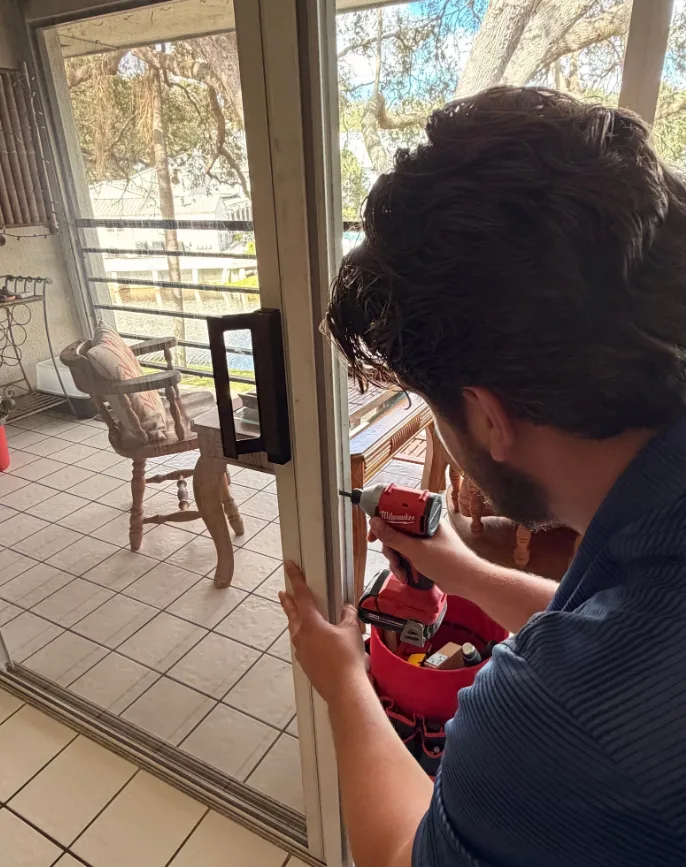
What we install on patio doors
- Primary hook lock repair/replacement - for worn factory hardware.
- Secondary pin locks - block vertical lift attacks.
- Charlie bars - prevent horizontal sliding bypass.
- Keyed secondary locks - add real security beyond hook.
- French door deadbolts - full keyed deadbolts on both leafs.
- Impact-door compatibility - NOA-approved hardware for hurricane doors.
- Track alignment - corrects binding and jumping tracks.
- Coastal-grade options - marine-rated hardware for beachfront homes.
Common patio door security problems
These are the situations where patio door security matters most.
Typical patio door installation scenarios
- Jensen Beach home with standard sliding patio door - owner wants pin lock added after nearby break-in.
- Vero Beach condo with worn factory hook that no longer engages the keeper. Full hook mechanism replacement.
- Stuart French doors with no deadbolt on the active leaf - adding keyed deadbolt for code compliance.
- Port St. Lucie home with impact-rated patio door and NOA-compliant hook failure. Replace with matching NOA hardware.
- Hutchinson Island oceanfront home with corroded sliding door cylinder. Replace with marine-grade stainless.
- Palm City home with sliding door that won't lock because of track misalignment. Track realignment plus new hook.
- Hobe Sound home with French patio doors needing matching deadbolts plus a secondary flush bolt.
- Tradition home adding Charlie bars to all patio doors as a family-wide security upgrade before vacation.
Patio door security options compared
Patio door security has three layers. First layer: the primary lock (factory hook-and-keeper or mortise deadbolt). This is the baseline and for most residential use, it's the weakest link.
Even Grade 1 patio door locks are easier to defeat than Grade 1 entry door deadbolts.
Second layer: secondary mechanical security. Pin locks drop through the top track into the frame, blocking vertical lift. Charlie bars wedge between the door and frame, blocking horizontal sliding.
Both are inexpensive ($15-$45 each) and effective. Most Treasure Coast homes should have both on every patio door.
Third layer: keyed secondary locks. These add a full pin tumbler cylinder to the patio door, typically mounted at shoulder height on the door frame, operated from both inside and outside. They provide real security similar to an entry deadbolt.
Cost is higher ($85-$145 per lock) but the security improvement is meaningful.
For French patio doors, the setup is different because French doors have two leafs that meet in the middle. The active leaf gets a keyed deadbolt. The inactive leaf gets flush bolts at top and bottom that manually lock the inactive side into the frame.
Without the flush bolts, the inactive leaf can be pried open regardless of the active leaf's deadbolt status.

How patio door lock installation works
Assessment call
Call (772) 758-1322. Describe the door type (sliding, French, impact-rated) and goals.
Onsite measurement
Technician measures the door and track, verifies door type and brand.
Hardware installation
Primary hook replacement, secondary locks, Charlie bars, or keyed secondary as needed.
Test and verification
Full operation test including vertical lift resistance and lock engagement.
Patio door security tips
- Always install a secondary pin lock on every sliding patio door. It's the single biggest security upgrade for $25.
- Charlie bars are visible deterrents - burglars see them and skip to easier targets.
- For French patio doors, verify the inactive leaf is anchored top and bottom with flush bolts. Skipping this is a common oversight.
- On impact-rated doors, keep all security hardware NOA-compliant or you lose the impact rating.
- Lubricate the track with dry silicone every 6 months. Salt and grit accumulation cause lock failures.
- Test your patio door locks quarterly. Unused locks seize from disuse, especially in humid environments.
Related services
Other Treasure Coast Locksmith services in this cluster.
Patio door lock installation FAQs
Common questions about patio door lock installation for Treasure Coast homes.
How much does patio door lock installation cost?
Primary hook replacement on a sliding door runs $125 to $245. Secondary pin lock installation runs $55 to $95. Charlie bar install runs $35 to $65 (mostly hardware cost).
Keyed secondary lock for a sliding door runs $145 to $245 installed. Full package (primary + pin + Charlie + keyed) runs $285 to $465 per lock.
Is a pin lock or Charlie bar better for security?
Both - they block different attacks. A pin lock prevents the vertical lift attack (removing the door from its track). A Charlie bar prevents the horizontal sliding attack (opening the door when the hook is defeated).
For maximum patio door security, install both. They complement each other and together cost under $60 in hardware.
Can you install locks on impact-rated patio doors?
Yes. Impact-rated patio doors require NOA-compliant secondary hardware to preserve the door's impact rating. We verify which secondary locks are NOA-approved for your specific door brand (PGT, CGI, WinDoor, ESW) before installation.
Do French doors need different locks than sliding doors?
Yes. French doors use keyed deadbolts like entry doors, typically one on each leaf. The inactive leaf also needs top and bottom flush bolts to lock it into the frame.
Sliding doors use hook-and-keeper mechanisms plus secondary pin locks and Charlie bars for vertical and horizontal bypass resistance.
Can patio door locks be rekeyed?
Some yes, some no. Keyed secondary locks on sliding doors use standard residential cylinders that can be rekeyed. The primary factory hook on a sliding door usually has a key cylinder that can sometimes be rekeyed.
French door deadbolts use standard pin tumbler cylinders that rekey normally.
Are secondary locks HOA-approved?
Most HOAs don't restrict interior-facing security hardware like pin locks and Charlie bars because they're not visible from outside. Exterior-visible secondary locks (keyed locks on French doors) may require HOA review. We verify before installation if the hardware is visible from the community-facing side.
How long does patio door installation take?
Primary hook replacement on a sliding door takes 45 to 75 minutes. Secondary pin lock installation takes 15 to 30 minutes per door. Charlie bar is 10 minutes.
Keyed secondary lock takes 45 to 75 minutes. A full patio door upgrade package (all four) takes 90 to 150 minutes per door.
Do you install locks on lanai sliders?
Yes. Lanai sliders are typically the same hardware as standard patio sliders. The primary differences are track material (often aluminum on lanais) and exposure to the outdoor environment.
We install the same hook replacements, pin locks, Charlie bars, and keyed secondary locks.
Can you fix a patio door that won't lock?
Yes. Patio doors that won't lock usually fail for one of three reasons: worn hook mechanism, misaligned keeper or strike, or bent door frame. We diagnose the specific cause and repair accordingly.
Most 'won't lock' problems are fixed in 60-90 minutes onsite.
What is a keyed secondary lock?
A keyed secondary lock is a pin tumbler cylinder mounted on the patio door frame that works independently of the factory hook. You turn a key to lock and unlock a deadbolt-style secondary bolt. It adds real security beyond the factory hook and gives you a backup if the primary lock fails.
Can I install a smart lock on a patio door?
Some sliding doors accept smart lock retrofits that interface with the existing hook mechanism. French doors accept standard smart deadbolts (Schlage Encode, Yale Assure) if the door is wide enough. For sliding doors, smart lock integration is complex and we typically recommend standard locks instead.
Are Charlie bars effective against determined burglars?
They're more effective than you might expect. A visible Charlie bar signals that the door is actively secured with a secondary measure, which deters most opportunistic burglars. Determined attackers can still defeat a Charlie bar with effort, but that effort takes time and attracts attention.
The deterrent value alone often justifies the minimal cost.